

Some of the most serious hazards in a home are small enough to disappear under a couch cushion. Button batteries and high-powered magnets can be found in toys, decorations, remote controls, electronic accessories, lights, gadgets, and everyday household products. When these small objects become accessible to children, the consequences can be far more serious than their size suggests.
The issue deserves particular attention in 2026. Recent U.S. Consumer Product Safety Commission recalls have involved products ranging from magnetic building cubes and fidget toys to LED tea lights and other products containing accessible coin batteries. That makes this a good time for families to inspect not only children’s toys but also ordinary objects throughout the home.
This guide focuses on prevention: knowing where these hazards hide, checking products before children use them, responding quickly if something may have been swallowed, and making product-safety reviews part of your regular home safety checklist.
Why Button Batteries and Magnets Can Become Medical Emergencies
A small object does not always mean a small injury. Button batteries and strong magnets create risks that are different from ordinary choking hazards. Even after an object has been swallowed successfully and is no longer blocking the airway, it may still cause serious internal damage.
That is why parents and caregivers should treat suspected ingestion as an urgent situation rather than waiting for symptoms to appear.
Why Button Batteries Are So Dangerous for Young Children
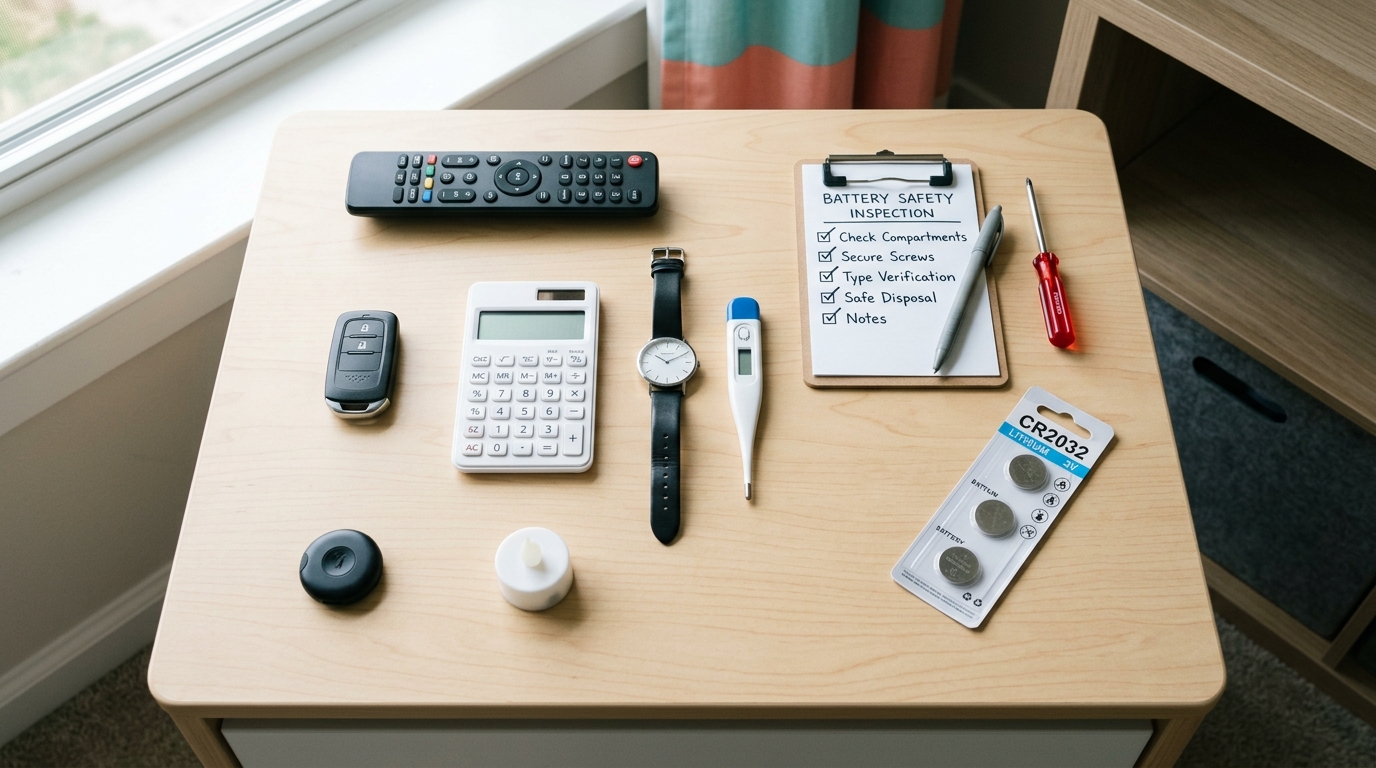
Button cells and coin batteries are used because they provide significant power in a very small package. Unfortunately, their smooth, shiny shape can make them attractive to young children who naturally explore objects with their mouths.
According to the U.S. Consumer Product Safety Commission, button and coin batteries are associated with thousands of emergency department visits each year. When certain batteries become lodged in the esophagus, an electrical reaction can cause severe tissue injury. CPSC warns that a battery can burn through a child’s throat or esophagus in as little as two hours.
A child does not have to open a toy store package to find one. Batteries may become accessible when a product breaks, a battery compartment opens without a tool, or an adult leaves a replacement or used battery on a counter while changing it.
Where Button Batteries May Be Hiding in Your Home
Start by looking beyond the toy box. Button or coin batteries may be found in key fobs, remote controls, bathroom scales, thermometers, flameless candles, small flashlights, watches, calculators, greeting cards, ornaments, children’s books with sound or light features, hearing devices, electronic accessories, small decorative lights, and novelty products.
Walk through rooms at your child’s eye level. Look for devices that can be reached from the floor, a couch, bedside table, kitchen counter edge, or low shelf.
Examine the battery compartment. A product containing a button battery should not allow a young child to open the compartment easily. CPSC specifically recommends looking for secure closures that require a screwdriver, coin, or tool. If a compartment is cracked, missing a screw, or no longer closes properly, move the product away from children and repair, replace, or dispose of it appropriately.
Do not forget loose batteries. New batteries should remain in secure packaging and stored high and out of children’s reach. Used batteries also retain enough energy to cause injury and should not be left loose in drawers, purses, recycling containers, or on countertops.
Parents of babies and toddlers may also want to review our Home Safety by Age guide because the risk changes considerably once a child begins crawling, climbing, opening drawers, and reaching higher surfaces.
What to Do If You Think a Child Swallowed a Button Battery
Do not wait for obvious symptoms. A child who has swallowed a button battery may initially appear well, and the ingestion itself may not have been witnessed.
If you know or suspect that a button or coin battery has been swallowed, seek emergency medical attention immediately. Do not deliberately make the child vomit and do not delay medical evaluation while trying to determine whether symptoms develop.
Keep the product, packaging, or an identical battery available if doing so does not delay care. That information may help medical professionals identify the battery involved.
CPSC recommends immediately contacting the National Battery Ingestion Hotline at 800-498-8666 or Poison Help at 800-222-1222 for treatment information while seeking appropriate medical care. Parents can review current official advice through the CPSC Button Cell and Coin Battery Information Center.
Because ingestion treatment is time-sensitive and depends on factors such as the child’s age, battery type, timing, and location of the battery, follow the instructions of medical professionals and current poison-control guidance rather than relying on a general home remedy.
High-Powered Magnets Create a Different Kind of Internal Danger
Small magnets may look like ordinary craft pieces, building components, fidget-toy parts, or jewelry accessories. High-powered magnets, however, can create a dangerous situation after ingestion that is very different from swallowing a single ordinary object.
The problem is attraction. If two strong magnets are swallowed at different times, they can attract one another even when they are in different loops of the digestive tract. A magnet can also attract another metal object that has been swallowed.
CPSC warns that this attraction can trap intestinal tissue between the objects. The resulting pressure can cause perforations, twisting, blockage, loss of blood supply, infection, and other life-threatening complications.
Why Missing Magnets Should Never Be Ignored
A magnetic toy that had 30 pieces yesterday should still have 30 pieces today. Counting magnetic components sounds tedious, but it can reveal a problem before anyone develops symptoms.
Inspect magnetic toys periodically for cracking, splitting, loose seams, or exposed magnets. If a toy breaks and you cannot account for every magnet, stop using it immediately and keep the remaining pieces away from children.
Do not assume this is only a toddler issue. CPSC specifically warns that high-powered magnet injuries can affect children from toddlers through teens. Older children may place magnets in their mouths while playing, use them to imitate tongue or lip piercings, or hold magnets with their teeth.
Recent recalls illustrate why product inspection matters. In August 2026, CPSC recalled magnetic building cubes because the magnets could become loose if the cubes broke or opened. Magnetic fidget sliders were also recalled because their casings could expose high-powered magnets.
If you believe a child swallowed one or more magnets, seek immediate medical attention. Symptoms such as abdominal pain, nausea, vomiting, and diarrhea can occur, but parents should not wait for these signs before acting when ingestion is suspected.
Make Battery and Magnet Checks Part of Your Family Safety Routine

The most effective prevention strategy is not memorizing every risky product. It is developing a repeatable way to inspect what enters and changes within your home.
Start with the products children use directly, then expand the review to household electronics, decorations, gifts, novelty items, craft supplies, older siblings’ belongings, and products purchased online.
Build a Five-Minute Product Safety Check Into Everyday Life
When a new toy or electronic product enters the home, inspect it before handing it to a child. Check the recommended age, packaging warnings, battery compartment, small components, magnetic pieces, and overall construction.
For products already in use, make inspection part of cleaning and organizing. Look for cracked housings, missing screws, broken battery doors, loose magnets, and parts that have separated from their original enclosure.
Families can use the following quick checklist:
- Store loose button and coin batteries where children cannot see or reach them.
- Check that battery compartments close securely and require a tool when appropriate.
- Immediately remove damaged electronic toys or products from children’s access.
- Keep high-powered magnetic sets away from young children.
- Count magnetic toy components before and after use when practical.
- Do not allow children to put magnets in their mouths or imitate body piercings with them.
- Keep older children’s magnetic toys separate from baby and toddler play areas.
- Check toys and household products periodically for recalls.
- Dispose of or recycle batteries according to applicable local procedures.
- Know how to reach poison-control and emergency medical services before an emergency occurs.
You can combine this inspection with the four-step routine from our Child Safety Checklists: assess the environment, address the hazard, teach safer habits, and review again as children grow.
Check Recalled Products Instead of Assuming a New Product Is Safe
A product being available for sale does not guarantee that it has never had a safety problem. Recalls and safety warnings may occur after products have already reached thousands of homes.
Check product names, manufacturers, model numbers, and recognizable product images against the CPSC recall database, especially if you notice accessible batteries, loose magnets, or broken components. This is particularly useful for products purchased through online marketplaces, received secondhand, or stored for years between siblings.
Parents should also avoid focusing only on items marketed specifically to children. Recent button-battery warnings and recalls have involved decorative lights and other household products that a curious child could still access.
For broader prevention, explore our Child Safety Topics page and New Parent Start Here resource. Families should also include battery and magnet checks when preparing grandparents’ homes, vacation rentals, hotel rooms, and other environments where children spend time.
Button batteries and high-powered magnets are difficult hazards because they can be easy to overlook until something goes wrong. The solution is not constant fear. It is awareness combined with a simple routine: identify products that contain these items, secure them correctly, inspect them for damage, monitor recalls, and act quickly when ingestion is suspected.
A five-minute inspection today can reveal a loose battery door, missing magnet, or recalled product before it becomes an emergency.